
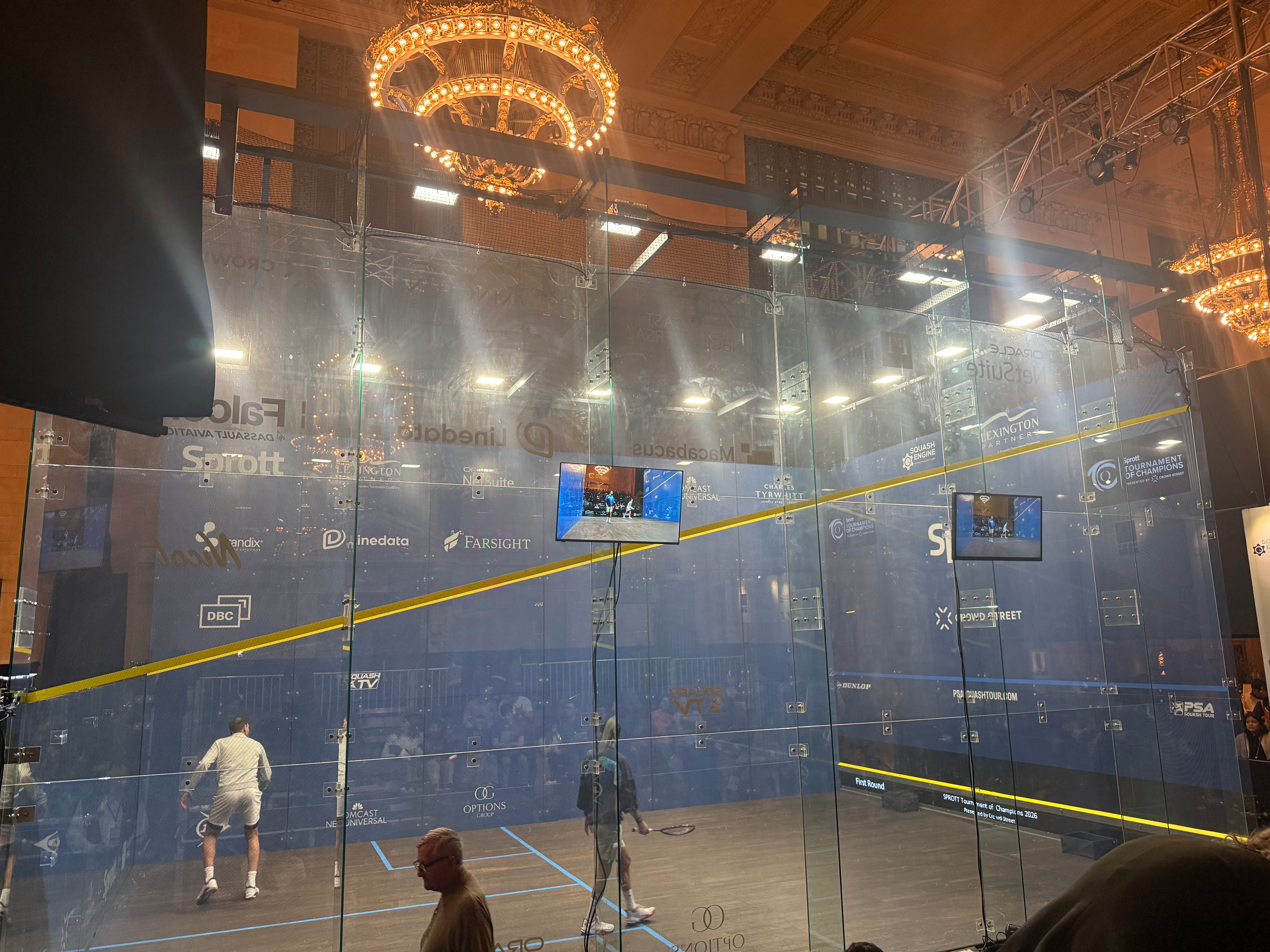
As Clubland USA’s chief (and only) squash correspondent, there’s nowhere that I’d rather be than on the back wall seats of the Tournament of Champions. Most of the time, I was confined to the stands, but in between games, pacing around, the socialising always took front stage, both with players and spectators alike.
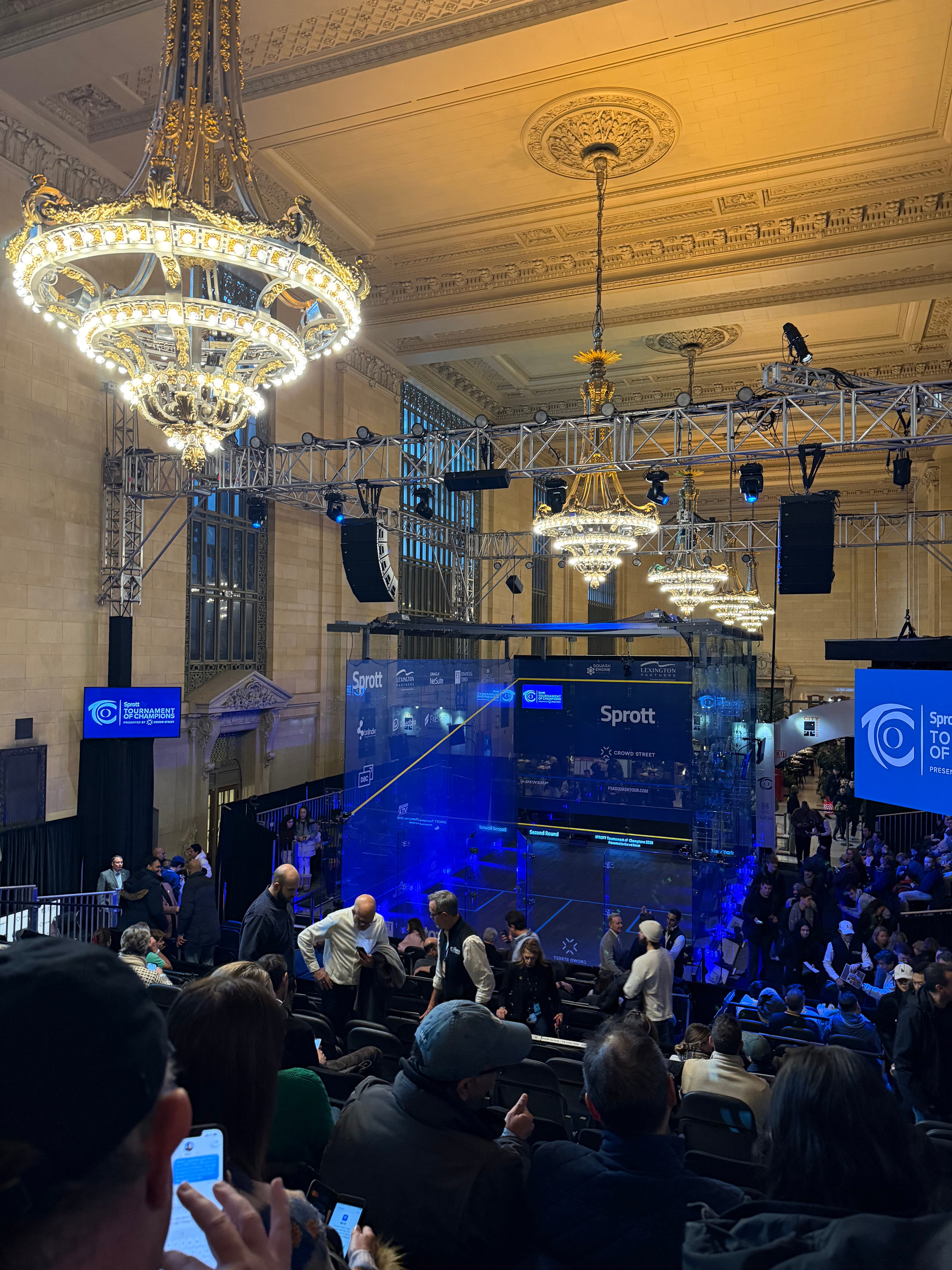
One of this publication’s first articles was our coverage of this esteemed tournament which is perhaps the greatest of the squash tournaments to ever be held in the United States. The Tournament of Champions brings the top 32 players on both the men’s and the women’s professional squash tours to a specially constructed glass court ensconced within Grand Central Terminal’s Vanderbilt Hall in New York City.
This year, I went back for more.
On Friday night, I had the pleasure of being seated alongside a convoy of squash fanatics from the Union League Club of New York.
Video: Juan Camilo Vargas, black, playing Mohammed ElShorbagy, blue in the 2026 ToC Round of 32.
Juan Camilo Vargas, #27, played Mohammed ElShorbagy, #10, in what was a display of terrific squash. Vargas pushed past his usual game and fought ElShorbagy until the very last, losing 11-9, 11-7, and 11-8—three terribly close games. Although this was Vargas’ first time on the glass court at ToC, playing against three-time ToC winner Elshorbagy, he’s likely to reprise his spot the next year and push through once again.
What was startling about Mohammed ElShorbagy’s game was how carefully and artfully he blocked Vargas, especially at crucial times. At the 9-9 point in the first game, Mohammed, who loomed over Vargas, hip checked Vargas in a manner that would not be susceptible to the cameras positioned behind him. It seems like blocking has been more or less accepted as part of the game in a way that would, in the pre-Asal years, get more ire from spectators.
Earlier that week, in the Round of 32, Timmy Brownell, #26, the highest ranked American male player on the tour, delivered a major upset, beating Mohammed ElShorbagy’s brother, Marwan, who is world #7. Brownell beat Marwan ElShorbagy in a gruelling match that lasted through four games, losing the first 9-11, and then proceeding to win 11-1, 13-11, 13-11, in a 61 minute battle of endurance and skill.
The following day, Brownell played against #20 player Jonah Bryant in the Round of 16. While Brownell, dressed like a Christmas tree, stepped on the court as if David had demolished Goliath, recently triumphant, 20-year-old British whiz-kid Jonah Bryant wasn’t in such a celebratory mood, and sure didn’t give Brownell occasion for it. Brownell played a clean game, and seemed more focused, but lost to Bryant 6-11, 5-11, 5-11 in a short match.
Video: Timmy Brownell, green, playing Jonah Bryant, blue, in the 2026 ToC Round of 16.
Brownell, to his credit, exhibited great sportsmanship in a sport that has been having quibbles with it. At the last point in the match, the referee made a call to not offer a Let to Bryant on what appeared to the audience to be a questionable call. It would have likely been a stroke, but the referee awarded a “no let”, which would have let Brownell play the last point again, in an attempt at a comeback. Brownell instead used his limited player reviews to request a review, and although it was still a no-let, it was a great show of collegiality and sportsmanship in a game where both young and old players like Mohammed Zakaria and Mostafa Asal are increasingly pushing the limits of what may be deemed sportsmanlike, in good faith and spirit.
On the women’s side, I saw Olivia Weaver, top-ranked American women’s squash player, go up against British-born Canadian Hollie Naughton. While the first game was close—11-9—Weaver dominated the next two games, finishing the match in a paltry 34 minutes. While it was not so fun to watch because of Weaver’s domination over Naughton, Weaver has been playing an advanced and mature game that is calm and temperate and consistent, and Naughton, whose game appears marginally more mercurial, couldn’t really keep up.
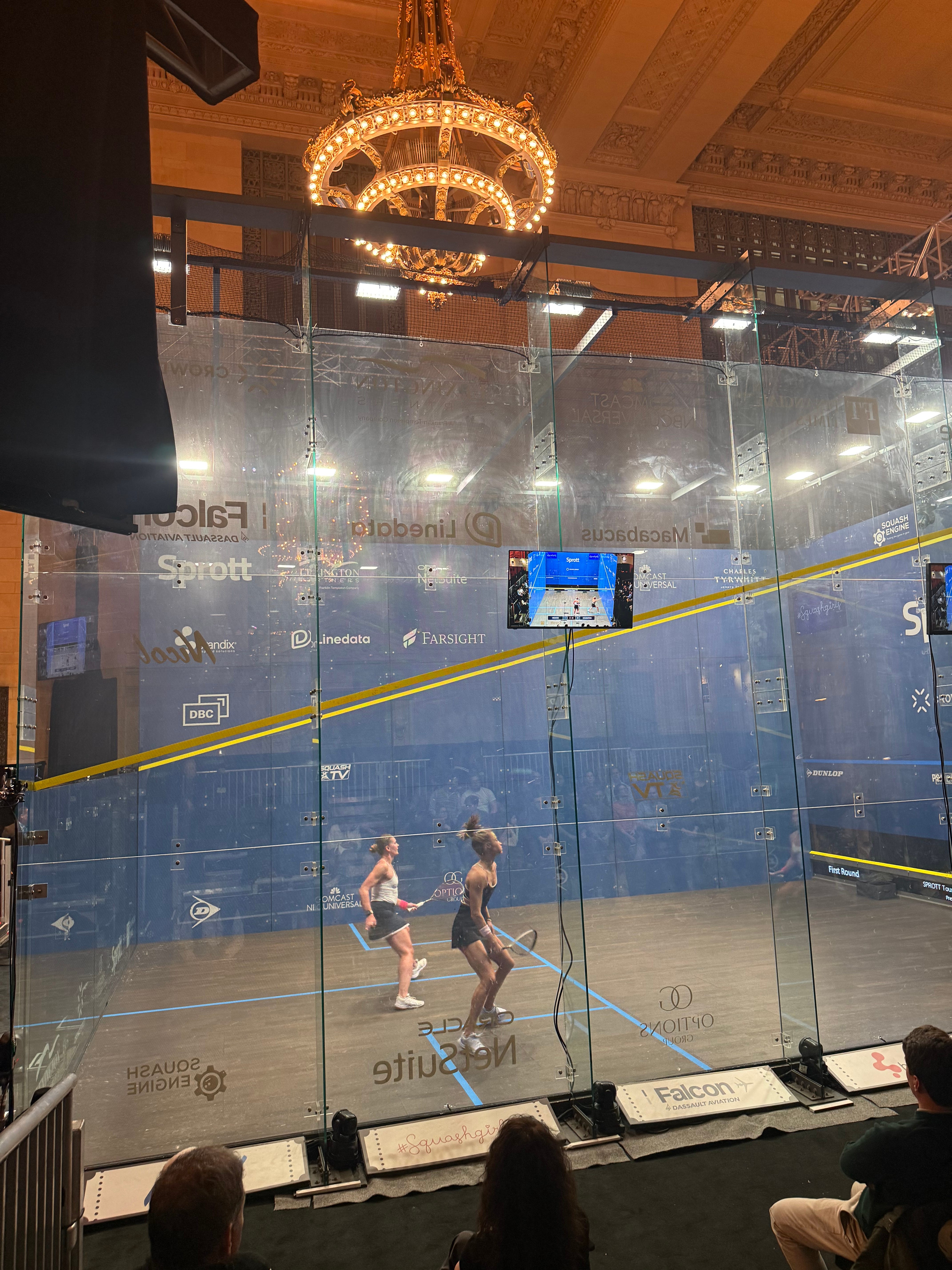
The following day was also the sight of another bloodbath on court, with the up-and-coming #16 British squash player Jasmine Hutton going up against the higher ranked #9, Belgian player Tinnie Gilis. Hutton was expected to lose in three, but you know the thing about predictions: when they’re wrong, they’re horribly wrong. Gilis appeared on court, mentally and physically taxed, and I wouldn’t blame her: it was 5 degrees Fahrenheit outside, and the wind wasn’t particularly helpful.
Hutton overpowered Gilis with her agile movement and accurate shots. Gilis responded by trying to shorten rallies, which more often than not ended in inaccurate and imprecise shots, and Gilis seemed rather out of it. Though she put up a tough fight, this was to the women’s game the equivalent of the Brownell-Elshorbagy upset, and Hutton beat Gilis in 3 games: 11-9, 11-5, 11-4, in a short 31 minutes.
Gilis’ sister, Nele Coll-Gilis, lost, like Tinnie, in the round of 16 to Egyptian wonderchild Amina Orfi in three, ending both sisters’ run at the ToC.
We’re excited to see how the ToC shapes up as it progresses into the quarterfinals, semifinals, and finals. Olivia Weaver is supposed to play Sivasangari Subramaniam, the Malaysian prodigy, in what is to be a close match with some brilliant squash on the glass court on 27 January at 7:30PM, followed closely by what is supposed to be another brilliant game—the Frenchman Victor Crouin going up against Kiwi Paul Coll, close enough to potentially create a tough fight for the lower-ranked Frenchman as he seeks to climb the rankings.
Before the finals, however, Spencer Lovejoy and the National Squash League will put on a wonderful exhibition on the same glass court at Vanderbilt Hall, which we will certainly be there for
.